My Baby Acts Like He Can't Find Nipple and Kicks Alot
When your baby squirms, appears uncomfortable during feed, fusses, cries or refuses a canteen, it tin can be challenge to figure out the cause. The timing and type of behavior she exhibits provides vital clues. This article discusses potential reasons for troubled feeding behavior.

Signs
Does your baby display troubled beliefs in relation to bottle-feeding, such equally….
 Refuses a bottle
Turning away from the canteen.
Refusing to close her oral fissure around the nipple.
Holding nipple in the oral fissure but non sucking.
Taking only a small corporeality and and then refusing more.
Screaming when placed into a feeding position or at the sight of the canteen.
Milk pouring out of babe's mouth.
Feeding too apace.
Feeding too slowly.
Falling asleep before the feed is completed.
Coughing and spluttering when feeding.
Not consuming every bit much milk equally expected.
Wanting more milk than expected.
Throwing upwardly large amounts of milk.
And so there may exist steps you tin take to remedy the situation.
Behavioral reasons
'Behavioral' means baby's behavior is in response to the circumstances rather than a physical cause. Behavioral reasons are the near common of all reasons for infant feeding bug. In that location are numerous behavioral reasons for a baby to experience feeding problems and/or display problematic feeding behavior. Mutual reasons include:
1. Misinterpreting baby'southward cues as signs of hunger
Does babe at times refuse feeds?
Does she take only a lilliputian and non desire more?
Babies are in an oral stage of develop. Sucking is the chief manner babies soothe. They also acquire by sucking and mouthing objects. Many babies have a strong desire to suck for reasons that extend across hunger, such every bit tiredness, boredom, discomfort and soothing. There may be times when you lot mistake your baby'south want to suck for these reasons as hunger.
Newborn babies take an agile sucking reflex. This means a newborn baby may accept a feed even when she'southward not hungry, and she might guzzle down the bottle because she cannot cull to not suck when her sucking reflex is triggered. Once her sucking reflex has disappeared (usually past 3 months of age) she volition willingly have merely the amount she wants to take.
If you lot have mistakenly interpret her fussing or desire to such as hunger and offer her a feed, she might take a little and decline the remainder, or she turn down from the start. If you endeavour to make her drink more she wants, she will understandably get upset and fuss, cry and pull back from the bottle.
WHAT TO Practise

See Hungry babe for more than reasons why babies often announced
See Infant reflexes
2. Unrealistic expectations
Is babe not drinking as much every bit you lot expect?
Is she fussing if you try to get her to finish?
In around one third of consultations I have had with parents regarding an infant feeding problem, I constitute that parents were trying to brand their infant drink more than he or she needed. In some cases, this was considering of errors made their health professionals. They either failed to accommodate calculations as baby matured or failed to consider babe every bit an private. Equally a issue, overestimated baby'southward milk requirements.
If you think your baby is not drinking enough milk (breast milk or infant formula) you're naturally going to feel concerned. If your business organisation translates into trying to pressure her to drink more than than she wants or needs (gently or otherwise), y'all're going to upset her. So information technology is very important for your peace of mind and your baby's enjoyment at feeding times that y'all take realistic expectations about how much she needs.
WHAT TO Exercise

Run across How much milk does babe need for standard estimations for age and weight, and reason why a baby might take more than or less than recommended.
Follow your infant'south feeding cues. Don't try to brand her take more when she indicates she has had enough.
3. Tiredness
Is your baby at times as well tired to consume effectively?
Does she ofttimes fall asleep while feeding?
Sleeping and feeding are closely related when information technology comes to the needs of babies. Both are equally important to a baby'southward health, growth and evolution and feelings of wellbeing. Yous are no doubt aware that if your baby does non feed well she might not sleep well. Only are you aware that the opposite is equally true. If she'southward not getting enough sleep this has the potential to negatively impact on her feeding.
Concrete fatigue can cause baby to fuss during feeds or falling asleep before the feed is completed. If yous have a hungry/tired baby on your hands, tiredness volition usually win out.
WHAT TO DO
Ensure baby gets enough sleep.
Feed her before she becomes too tired.
Aim to establish a flexible feeding and sleep routine to minimize the take a chance of feeding and sleep times clashing.
If your infant is oftentimes irritable and non sleeping enough, (come across Overtired baby for signs and symptoms) you might notice that resolving any underlying sleeping trouble will cause feeding difficulties to spontaneously resolve once she receives acceptable sleep.
Meet our sleep section.
Download or order a paperback copy of my baby slumber book Your Sleepless Baby: The Rescue Guide. There yous will detect comprehensive information on the reasons and solutions to various infant sleeping issues.
iv. Distractibility
Is your baby besides busy looking around or trying to play to want to feed?
Is information technology hard to keep her focused on feeding?
Babies over the age of 4 months can easily become distracted while feeding. They are oftentimes much more interested in the activities going on around them than they are in feeding.
WHAT TO Exercise
Feed your babe in a quiet environment away from noise and distractions of other children.
five. Feeding management
Some feeding problems can be related to what may appear similar insignificant details but which tin make feeding hard or uncomfortable for a baby. For example, how y'all concur your babe will affect her ability to feed from a bottle. If her head is too far forward or too far back or her neck is twisted this tin make it difficult for her to suck or swallow.
WHAT TO Practice
Run across How to canteen-fed a baby
half-dozen. Feeding aversion
Does your babe refuse to feed even when hungry?
Does she scream at the sight of a bottle or when placed into a feeding position?
Have you resorted to trying to feed her while asleep?
A babe can develop an aversion to feeding when past feeding experiences have taught her that feeding is unpleasant, stressful or painful. Typically, baby is diagnosed with reflux and/or milk protein allergy or intolerance to explain her aversive feeding behavior. However, a behavioral feeding aversion (related to feeding management rather than a concrete cause) is a far more than mutual cause of infant feeding aversion.
A feeding aversion is the well-nigh complex of all babe feeding problems. An effective solution relies heavily on accurateidentification of the crusade.
WHAT TO Practise
Come across Feeding aversion for more than data. Or purchase or download a re-create of 'Your Babe's Bottle-Feeding Aversion: Reasons and Solutions'.

vii. Feeding equipment
Does your babe gag, cough or splutter during feed?
Does she make clicking sounds while feeding?
Information technology could be the nipple is as well long, too brusk, too fast or as well deadening.
The most important piece of feeding equipment is the nipple. The nipple needs to be the right size and speed for your babe's size, historic period and sucking ability. If the nipple is too long, likewise short, too fast or too boring for your baby, she may feel feeding difficulties and express her frustration by fuss or crying.
WHAT TO Do
Run into Feeding equipment for more than information on choosing a feeding nipple.
Experiment with nipples of different lengths, shapes and speed.
8. The nipple ring is screwed as well tight
Does the nipple plummet in your baby's mouth as she feeds?
Do you observe that air rushes into the bottle in one case the canteen is removed from her mouth?
Its possible her feeding difficulties could exist due to the nipple band beingness screwed on too tight.
In guild to maintain a neutral balance in air pressure within the bottle air needs to be able to enter the bottle to supersede the void left past the milk the baby is removing. If the bottle is vented, this is achieved via the venting arrangement. However, in the example of a non-vented canteen, the only ways air can enter the canteen are between the nipple ring and the rim of the bottle and through the holes at the end of the nipple. While sucking, a babe volition maintain a seal over the holes at the end of the nipple with her tongue and prevent air entry in this mode. If the nipple ring is screwed down tightly this too prevents air entry.
If air is prevented from entering the bottle, this causes a negative pressure to build in the bottle. Every bit the pressure level builds, baby need to piece of work harder and harder to extract further milk, until such time and the air pressure level is returned to normal. The effort required to suck against the negative pressure can cause a newborn babe to tire and fall asleep before completing the feed. An older baby may simply surrender or limited her frustration.
WHAT TO DO
The nipple collapsing (not all will) or stopping to burp baby allows air to enter through the holes and neutralize the force per unit area. But you lot don't want to expect for this to resolve the problem. Past then baby is already tiring or getting frustrated. See 'Collapsing nipple' for means to manage this problem.
nine. Feeding patterns
Is your infant often have only small amounts, decline more, simply so wants to feed over again an hour or two after?
Some babies develop a grazing or snacking feeding pattern where they will only drink small amounts of formula at a fourth dimension and then want to be feed often, maybe every hour or two. Although this will not crusade any problems for a baby, provided she drinks enough formula in total over a 24 hour period, it can become very tiring for parents to keep up with her constant demands for feeding.
WHAT TO Practise
Effort to encourage your baby to take as much milk as possible within 45 minutes. But don't try to make her feed if she doesn't want to. Stop sooner if she does not want to continue.
Ensure babe gets plenty of sleep.
Avert allowing baby to fall asleep while feeding.
Support your baby to extend the time betwixt feeds, past offering a piffling water, a pacifier, a nap, playing with her, or taking her for a walk. Aim to encourage her to wait at least 3 hours from time you started her previous feed, but merely if its reasonable to do and then without lamentable her. If necessary extend the time between feeds gradually. Equally your babe gets used to going longer periods between feeds she will gradually take larger amounts at each feed.
ten. Excessive night feedings
Is baby feeding more often at dark than you lot would expect?
Unless your babe was born prematurely or is very pocket-size for her age, developmentally she no longer requires feeding during the night beyond the age 6 months. If nighttime feeding continues past this age its not going to harm her but it could take a negative issue on her appetite and feeding patterns during the day.
Your baby only needs a certain number of calories in her day (24 hours) to provide for her growth and free energy needs. If after the age of 6 months she continues to receive calories from nighttime feeds this volition dampen her appetite during the day and she will non need to drink as much formula during daytime feeds. You might discover she is content to go for long periods of time betwixt feeds (which is commonly what would happen at night). She might fuss or refuse some of her daytime bottles when they are offered simply because she's not hungry at the time. Or she might graze during the solar day.
Nighttime feeding will cause your baby no harm, so if y'all're happy to proceed feeding her during the dark in that location's no reason to change a affair. Notwithstanding, it is of import that you lot don't expect her to consume as much milk during the solar day as she may have otherwise taken if she did not feed at night.
Many babies will surrender night time feedings on their own accord, simply others volition continue to wake and demand feeds overnight for months and possibly years while parents continue to provide feeds at night. Unremarkably the reason babies continues to need night feeds beyond the age of 6 months is because they have learned to rely on feeding as a way to fall comatose, or because their internal body clock gets turned around - where the baby has decreased appetite during the day because of the continued night feeds and as a consequence of small feeds during the day the infant wakes hungry during the night. Body clock problems can easily get a cyclical pattern that volition continue over the long term unless parents take steps to change the situation. Salubrious, thriving babies who continue to demand feedings at night beyond the age of 6 months ofttimes crave guidance and support from parents to finish feeding at night and plow their body clock around to a normal twenty-four hours-night feeding pattern.
WHAT TO DO
Aim to cease overnight feeds after 6 months of age. However, before attempting to do this its important to address any feeding to sleep issues your infant might have. She would need to learn to autumn asleep in a unlike style before you volition exist able to successfully encourage her to stop dark feeds.
xi. Starting solids early on
Accept you started giving your baby solids before the historic period of 4 months?
6 months is the recommended age for starting solid foods. Although a modest number of babies may do good from solids prior to this age, it's more often than not not recommended to start a baby on solid foods before the age of iv months. An early get-go on solids has the potential to cause bottle feeding bug because solid foods may decrease the baby's appetite for milk (breast milk or formula).
WHAT TO DO
If your babe is less than 6 months old, either finish or reduce the amount of solids you offering to see if this helps to improve the state of affairs.
Come across our article on starting solids.
12. Solids eaten before or between formula feeds
Do you give infant solids between or earlier bottle feeds?
If solids are offered prior to bottle feeds, either directly earlier or mid way between feeds, when it'south time for your babe'south bottle feed she might be feeling total from the solids, in which case she's probably not going to take much milk from her bottle.
WHAT TO DO
For babies iv - 9 months (when milk is yet the most important food) offer solids 15 - 20 minutes later on bottle feeds.
For babies 9 - 12 months (when solids are becoming increasingly more important to a baby'southward nutrition) offering solids shortly before or presently afterwards her bottle, whichever you find works all-time. Babies at this age are often downwardly to iii bottles per day plus 3 main meals and 1 or 2 snacks.
xiii. Too much solids
Does your baby love solids and then much that she would rather consume solids than drink milk?
In these early stages of learning to eat solids (4 - 7 months) solids are not needed to add value to a baby's nutritional intake, rather they are offered primarily to provide learning experiences. The baby is exposed to new food proteins that aid prime number her immune organisation. She gets to find new tastes and textures and become accustomed to eating from a spoon. It is at this age that babies are most willing to accept new tastes. So multifariousness rather than quantity is what solids are about.
Many babies, particularly very young babies, experience difficulty cocky-regulating their dietary intake. Some babies will continue to consume solid foods for as long their parents continue offering. Some babies will prefer eating solids compared to drinking formula. However, too much solids and not enough milk is not a residual nutrition for a babe. It may be necessary for parents to limit the amount of solids they offering in order to encourage their infant to have a greater appetite for milk feeds.
WHAT TO DO
Meet our article on estimating how much milk your baby needs to make sure she'southward getting enough.
xiv. Weaning difficulties
Does your breastfed baby refusing bottle-feeds?
While some breastfed babies willing accept milk from a bottle many will non, at to the lowest degree non straight away.
Difficulty weaning from chest to bottle is rarely resolved by finding the 'right' feeding nipple. (All feeding nipples volition feel equally foreign to a breastfed baby.) Nor does a solution lie in finding a formula with the 'right' gustation. All formula will gustation strange to a breastfed baby). The difficulty associated with weaning to a canteen nigh often lies in the fact that bottle-feeding requires a very different sucking action to breastfeeding. While breastfeeding the move of your infant'south tongue milks the breast, where as bottle-feeding requires a sucking action. A baby who has been exclusively breastfed beyond the age of 3 months will frequently turn down milk from a canteen considering it "doesn't feel right" and she doesn't know how to suck from a bottle.
It takes fourth dimension and practice earlier a breastfed baby learns how to suck on a bottle.
WHAT TO DO
Endeavour offering expressed breast milk in a bottle initially. (Don't be too optimistic and put besides much in to start with. Information technology would be a shame to waste matter information technology.)
A soft flexible nipple frequently works better.
Note: Many chest fed babies volition turn down to accept a bottle while they are yet being breastfed at times. They will simply look until a breastfeed is offered. For these babies information technology will be the case of breastfeeding or canteen-feeding, but not both.
How nosotros can help
- Your Baby'south Bottle-feeding Aversion book
- Baby Intendance Adviceconsultation
- Rowena Bennett'sOnline Canteen-Feeding Aversion Plan
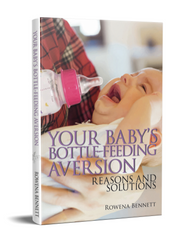
'Your Baby'southward Bottle-Feeding Aversion' book
In my book, 'Your baby's Bottle-feeding Aversion', I have described physical and behavioral reasons for babies to develop an aversion to bottle-feeding. How to identify the cause and the solutions to match. Included are stride-past-step instructions on how to regain your babe'due south trust and resolve a feeding aversion caused or reinforced by repeated pressure to feed.
While the book was written for bottle-fed babies, many nursing mothers take constitute that applying the same strategies has as well helped them to successfully resolve a breastfeeding disfavor.
You might find that reading this volume is all you lot need to practise to understand the steps you demand to take to resolve your baby's feeding aversion and go him back to the point of enjoying eating until satisfied.
Baby Intendance Advice Consultations
If you would similar an individualized assessment of all reasons for baby feeding bug, not merely feeding aversion, nosotros likewise provide a consultation service. Baby Intendance Advice consultants take all-encompassing experience in pinpointing the crusade of feeding aversion and other behavioral feeding bug such equally those related to equipment and the parent's feeding practices. (Formoreon what's included in a consultation).
Past Rowena Bennett, RN, RM, CHN, MHN, IBCLC.
Copyright www.babycareadvice.com 2021. All rights reserved. Permission from the author must be obtained to reproduce all or any part of this article.
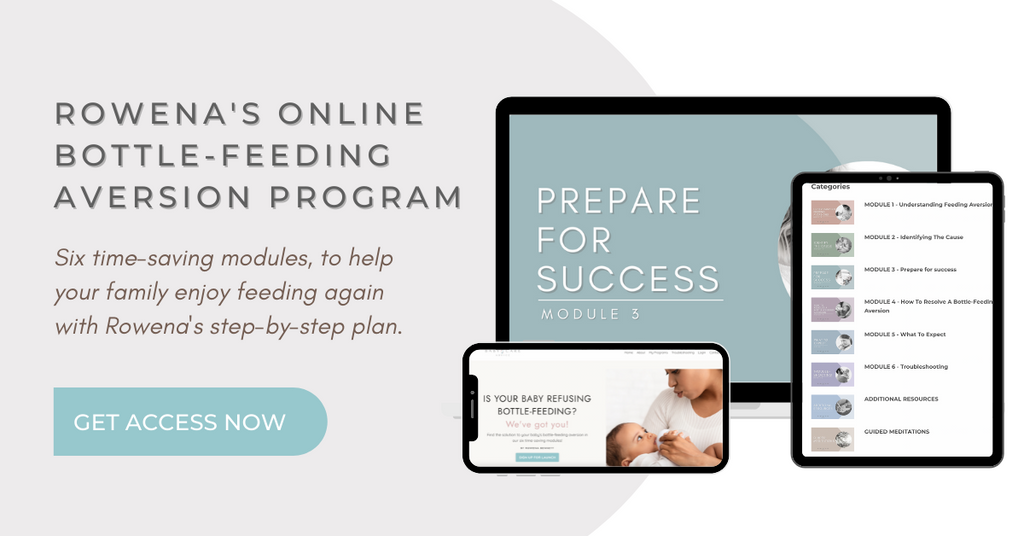
Rowena'southward Online Canteen-Feeding Aversion Program
Half dozen time-saving modules to help your family savour feeding again with Rowena's step-by-step plan. Enjoy additional tools to manage feet, troubleshoot whatever bug, introduce new carers, how to manage illness/teething and much more.
- Module 1: Agreement feeding aversions
- Module two: Identify the crusade
- Module 3: Prepare for success
- Module iv: How to resolve your baby's bottle-feeding aversion
- Module 5: What to look
- Module six: Troubleshooting
- BONUS: Guided meditations


Source: https://www.babycareadvice.com/blogs/bottle-feeding/bottle-feeding-problems
0 Response to "My Baby Acts Like He Can't Find Nipple and Kicks Alot"
Post a Comment