Peter Fogel Til Death Art Serve S Florida Nites
| Robert Rauschenberg | |
|---|---|
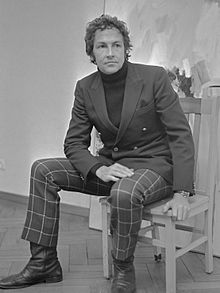 Rauschenberg in 1968 | |
| Built-in | Milton Ernest Rauschenberg (1925-10-22)October 22, 1925 Port Arthur, Texas, US |
| Died | May 12, 2008(2008-05-12) (anile 82) Captiva, Florida, US |
| Teaching | Kansas Metropolis Art Institute Académie Julian Black Mountain College Fine art Students League of New York |
| Known for | Aggregation |
| Notable piece of work | Canyon (1959) Monogram (1959) |
| Motility | Neo-Dada, Abstract Expressionism |
| Spouse(due south) | Susan Weil (yard. 1950; div. 1953) |
| Awards | Leonardo da Vinci World Award of Arts (1995) Praemium Imperiale (1998) |
Milton Ernest "Robert" Rauschenberg (October 22, 1925 – May 12, 2008) was an American painter and graphic artist whose early works predictable the Pop art motility. Rauschenberg is well known for his Combines (1954–1964), a group of artworks which incorporated everyday objects equally art materials and which blurred the distinctions between painting and sculpture. Rauschenberg was both a painter and a sculptor, but he also worked with photography, printmaking, papermaking and performance.[1] [2]
Rauschenberg received numerous awards during his well-nigh 60-year artistic career. Among the most prominent were the International Grand Prize in Painting at the 32nd Venice Biennale in 1964 and the National Medal of Arts in 1993.[iii]
Rauschenberg lived and worked in New York City and on Captiva Island, Florida, until his decease on May 12, 2008.[4]
Life and career [edit]
Rauschenberg was born Milton Ernest Rauschenberg in Port Arthur, Texas, the son of Dora Carolina (née Matson) and Ernest R. Rauschenberg.[v] [6] [seven] His father was of High german and Cherokee ancestry and his mother of Dutch descent.[8] His male parent worked for Gulf States Utilities, a light and ability company. His parents were Fundamentalist Christians.[9] He had a younger sister named Janet Begneaud.[10] [11]
At 18, Rauschenberg was admitted to the Academy of Texas at Austin where he began studying pharmacology, simply he dropped out shortly afterwards due to the difficulty of the coursework—not realizing at this bespeak that he was dyslexic—and because of his unwillingness to dissect a frog in biology class.[12] He was drafted into the United states Navy in 1944. Based in California, he served equally a neuropsychiatric technician in a Navy infirmary until his discharge in 1945 or 1946.[12]
Rauschenberg after studied at the Kansas City Art Institute and the Académie Julian in Paris,[13] France, where he met fellow fine art educatee Susan Weil. In 1948 Rauschenberg joined Weil in enrolling at Black Mount College in Due north Carolina.[14] [15]
At Black Mountain, Rauschenberg sought out Josef Albers, a founder of the Bauhaus in Federal republic of germany, whom he had read about in an August 1948 issue of Time magazine. He hoped that Albers' rigorous teaching methods might curb his habitual sloppiness.[16] Albers' preliminary design courses relied on strict discipline that did not let for any "uninfluenced experimentation."[17] [18]
Rauschenberg became, in his ain words, "Albers' dunce, the outstanding example of what he was not talking about".[19] Although Rauschenberg considered Albers his nearly important teacher, he found a more than compatible sensibility in John Cage, an established composer of avant-garde music. Like Rauschenberg, Cage had moved away from the authoritarian teachings of his teacher, Arnold Schönberg, in favor of a more experimentalist approach to music. Cage provided Rauschenberg with much-needed back up and encouragement during the early on years of his career, and the ii remained friends and creative collaborators for decades to follow.[16]
From 1949 to 1952 Rauschenberg studied with Vaclav Vytlacil and Morris Kantor at the Art Students League of New York,[20] where he met fellow artists Knox Martin and Cy Twombly.[21]
Rauschenberg married Susan Weil in the summertime of 1950 at the Weil family dwelling in Outer Island, Connecticut. Their only kid, Christopher, was born July xvi, 1951. The two separated in June 1952 and divorced in 1953.[22] Thereafter, Rauschenberg had romantic relationships with fellow artists Cy Twombly and Jasper Johns, amidst others.[23] [24] His partner for the final 25 years of his life was artist Darryl Pottorf,[25] his sometime assistant.[xx]
In the 1970s he moved into NoHo in Manhattan in New York Metropolis.[26]
Rauschenberg purchased the Beach House, his showtime property on Captiva Island, on July 26, 1968. All the same, the belongings did not become his permanent residence until the autumn of 1970.[27]
Rauschenberg died of heart failure on May 12, 2008, on Captiva Island, Florida.[28] [29]
Creative contribution [edit]
Rauschenberg's arroyo was sometimes chosen "Neo-Dadaist," a label he shared with the painter Jasper Johns.[xxx] Rauschenberg famously stated that "painting relates to both fine art and life," and he wanted to work "in the gap between the ii."[31] Like many of his Dadaist predecessors, Rauschenberg questioned the distinction betwixt art objects and everyday objects, and his apply of readymade materials reprised the intellectual problems raised by Marcel Duchamp'south Fountain (1917). Duchamp'southward Dadaist influence tin can too be observed in Jasper Johns' paintings of targets, numerals, and flags, which were familiar cultural symbols: "things the mind already knows."[32]

At Blackness Mountain College, Rauschenberg experimented with a variety of artistic mediums including printmaking, drawing, photography, painting, sculpture, and theatre; his works often featured some combination of these. He created his Night Blooming paintings (1951) at Black Mountain by pressing pebbles and gravel into black pigment on sail. In the very same year he made full torso blueprints in collaboration with Susan Weil in his New York flat, which "they hope to plow [...] into screen and wallpaper designs".[33]
From the fall of 1952 to the spring of 1953, Rauschenberg traveled in Italy and Northward Africa with his fellow creative person and partner Cy Twombly. There, he created collages and small sculptures, including the Scatole Personali and Feticci Personali, out of institute materials. He exhibited them at galleries in Rome and Florence.[34] To Rauschenberg's surprise, a number of the works sold; many that did not he threw into the river Arno, following the proposition of an art critic who reviewed his show.[35] [36]
Upon his return to New York Metropolis in 1953, Rauschenberg began creating sculpture with plant materials from his Lower Manhattan neighborhood, such as chip metallic, woods, and twine.[37] Throughout the 1950s, Rauschenberg supported himself by designing storefront window displays for Tiffany & Co. and Bonwit Teller, first with Susan Weil and later in partnership with Jasper Johns nether the pseudonym Matson Jones.
In a famously cited incident of 1953, Rauschenberg requested a drawing from the Abstract Expressionist painter Willem de Kooning for the express purpose of erasing it every bit an artistic statement. This conceptual piece of work, titled Erased de Kooning Drawing, was executed with the elder artist's consent.[38] [39]
In 1961, Rauschenberg explored a like conceptual approach by presenting an idea every bit the artwork itself. He was invited to participate in an exhibition at the Galerie Iris Clert in Paris, where artists were to present portraits of Clert, the gallery owner. Rauschenberg's submission consisted of a telegram declaring "This is a portrait of Iris Clert if I say so."[xix]
By 1962, Rauschenberg'southward paintings were beginning to contain not merely found objects merely found images as well. After a visit to Andy Warhol's studio that year, Rauschenberg began using a silkscreen process, normally reserved for commercial means of reproduction, to transfer photographs to canvas.[40] The silkscreen paintings made betwixt 1962 and 1964 led critics to identify Rauschenberg's work with Pop art.
Rauschenberg had experimented with engineering in his artworks since the making of his early Combines in the mid-1950s, where he sometimes used working radios, clocks, and electric fans as sculptural materials. He afterwards explored his interest in technology while working with Bell Laboratories research scientist Billy Klüver. Together they realized some of Rauschenberg'due south virtually ambitious applied science-based experiments, such as Soundings (1968), a light installation which responded to ambience audio. In 1966, Klüver and Rauschenberg officially launched Experiments in Art and Technology (E.A.T.), a non-profit system established to promote collaborations betwixt artists and engineers.[41] [42]

Robert Rauschenberg, Untitled, 1963, oil, silkscreen, metal, and plastic on sheet
In 1969, NASA invited Rauschenberg to witness the launch of Apollo 11. In response to this landmark event, Rauschenberg created his Stoned Moon Series of lithographs.[43] This involved combining diagrams and other images from NASA's archives with his own drawings and handwritten text.[44] [45]
From 1970, Rauschenberg worked from his habitation and studio in Captiva, Florida. The first works he created in his new studio were Cardboards (1971–72) and Early Egyptians (1973–74), for which he relied on locally sourced materials such equally paper-thin and sand. Where his previous works had often highlighted urban imagery and materials, Rauschenberg now favored the consequence of natural fibers found in fabric and paper. He printed on textiles using his solvent-transfer technique to brand the Hoarfrost (1974–76) and Spread (1975–82) series; the latter featured large stretches of collaged material on wood panels. Rauschenberg created his Jammer (1975–76) series using colorful fabrics inspired past his trip to Ahmedabad, India, a city famous for its textiles. The imageless simplicity of the Jammer series is a hit contrast with the image-filled Hoarfrosts and the grittiness of his earliest works made in New York Urban center.
International travel became a key part of Rauschenberg'south creative procedure later 1975. In 1984, Rauschenberg announced the get-go of his Rauschenberg Overseas Culture Interchange (ROCI) at the United Nations. Nearly entirely funded by the artist, the ROCI project consisted of a 7-year tour to ten countries around the globe. Rauschenberg took photographs in each location and made artworks inspired by the cultures he visited. The resulting works were displayed in a local exhibition in each land. Rauschenberg frequently donated an artwork to a local cultural institution.[46]
Beginning in the mid-1980s, Rauschenberg focused on silkscreening imagery onto a variety of differently treated metals, such equally steel and mirrored aluminum. He created many serial of so-chosen "metal paintings," including: Borealis (1988–92),[47] Urban Bourbons (1988–1996), Phantoms (1991), and Night Shades (1991).[48] In addition, throughout the 1990s, Rauschenberg continued to use new materials while still working with more rudimentary techniques. As part of his engagement with the latest technological innovations, in his belatedly painting series he transferred digital inkjet photographic images to a variety of painting supports. For his Arcadian Retreats (1996) he transferred imagery to wet fresco. In keeping with his commitment to the surround, Rauschenberg used biodegradable dyes and pigments, and h2o rather than chemicals in the transfer process.[49]
The White Paintings, black paintings, and Carmine Paintings [edit]
In 1951 Rauschenberg created his White Painting series in the tradition of monochromatic painting established by Kazimir Malevich, who reduced painting to its most essential qualities for an experience of artful purity and infinity.[fifty] The White Paintings were shown at Eleanor Ward'southward Stable Gallery in New York in fall 1953. Rauschenberg used everyday white house paint and paint rollers to create smooth, unembellished surfaces which at first announced as blank sheet. Instead of perceiving them to be without content, however, John Muzzle described the White Paintings every bit "airports for the lights, shadows and particles";[51] surfaces which reflected delicate atmospheric changes in the room. Rauschenberg himself said that they were affected by ambient atmospheric condition, "then you could virtually tell how many people are in the room." Like the White Paintings, the blackness paintings of 1951–1953 were executed on multiple panels and were predominantly single color works. Rauschenberg applied matte and glossy black paint to textured grounds of newspaper on sheet, occasionally allowing the newspaper to remain visible.
By 1953 Rauschenberg had moved from the White Painting and black painting series to the heightened expressionism of his Red Painting serial. He regarded red as "the most hard colour" with which to paint, and accustomed the claiming past dripping, pasting, and squeezing layers of red pigment direct onto sail grounds that included patterned textile, newspaper, woods, and nails.[52] The complex material surfaces of the Cherry-red Paintings were forerunners of Rauschenberg's well-known Combine series (1954-1964).[50]
Combines [edit]
Rauschenberg collected discarded objects on the streets of New York City and brought them back to his studio where he integrated them into his work. He claimed he "wanted something other than what I could make myself and I wanted to use the surprise and the collectiveness and the generosity of finding surprises. [...] Then the object itself was changed past its context and therefore it became a new thing."[39]
Rauschenberg'due south comment concerning the gap betwixt art and life provides the difference bespeak for an understanding of his contributions as an artist.[31] He saw the potential beauty in near anything; he once said, "I really experience pitiful for people who think things like soap dishes or mirrors or Coke bottles are ugly, because they're surrounded by things like that all solar day long, and it must brand them miserable."[53] His Combine series endowed everyday objects with a new significance past bringing them into the context of fine art alongside traditional painting materials. The Combines eliminated the boundaries betwixt art and sculpture and so that both were present in a single work of art. While "Combines" technically refers to Rauschenberg's work from 1954 to 1964, Rauschenberg connected to employ everyday objects such every bit wear, newspaper, urban debris, and paper-thin throughout his artistic career.

Robert Rauschenberg, Canyon, 1959, Combine painting
His transitional pieces that led to the cosmos of Combines were Charlene (1954) and Collection (1954/1955), where he collaged objects such as scarves, electric light bulbs, mirrors, and comic strips. Although Rauschenberg had implemented newspapers and patterned textiles in his black paintings and Red Paintings, in the Combines he gave everyday objects a prominence equal to that of traditional painting materials. Considered one of the first of the Combines, Bed (1955) was created past smearing red paint beyond a well-worn quilt, sail, and pillow. The work was hung vertically on the wall like a traditional painting. Considering of the intimate connections of the materials to the artist'south ain life, Bed is often considered to be a self-portrait and a direct imprint of Rauschenberg's interior consciousness. Some critics suggested the work could be read as a symbol for violence and rape,[54] but Rauschenberg described Bed as "one of the friendliest pictures I've ever painted."[37] Among his most famous Combines are those that incorporate taxidermied animals, such as Monogram (1955–1959) which includes a blimp angora goat, and Coulee (1959), which features a stuffed golden eagle. Although the eagle was salvaged from the trash, Canyon drew regime ire due to the 1940 Bald and Gilded Eagle Protection Act.[55]
Critics originally viewed the Combines in terms of their formal qualities: color, texture, and limerick. The formalist view of the 1960s was later refuted past critic Leo Steinberg, who said that each Combine was "a receptor surface on which objects are scattered, on which data is entered."[56] According to Steinberg, the horizontality of what he called Rauschenberg's "flatbed picture plane" had replaced the traditional verticality of painting, and after allowed for the uniquely material-bound surfaces of Rauschenberg'due south piece of work.
Operation and dance [edit]
Rauschenberg began exploring his interest in trip the light fantastic toe after moving to New York in the early 1950s. He was first exposed to avant-garde trip the light fantastic and performance fine art at Black Mountain Higher, where he participated in John Cage'southward Theatre Piece No. ane (1952), often considered the kickoff Happening. He began designing sets, lighting, and costumes for Merce Cunningham and Paul Taylor. In the early 1960s he was involved in the radical dance-theater experiments at Judson Memorial Church in Greenwich Village, and he choreographed his first functioning, Pelican (1963), for the Judson Dance Theater in May 1963.[57] Rauschenberg was shut friends with Cunningham-affiliated dancers including Carolyn Brown, Viola Farber, and Steve Paxton, all of whom featured in his choreographed works. Rauschenberg's full-time connexion to the Merce Cunningham Dance Visitor ended post-obit its 1964 globe tour.[58] In 1966, Rauschenberg created the Open up Score performance for function of nine Evenings: Theatre and Engineering at the 69th Regiment Arsenal, New York. The series was instrumental in the formation of Experiments in Art and Technology (East.A.T.).[59] [60]
In 1977 Rauschenberg, Cunningham, and Cage reconnected as collaborators for the get-go fourth dimension in xiii years to create Travelogue (1977), for which Rauschenberg contributed the costume and set designs.[49] Rauschenberg did not choreograph his own works after 1967, simply he connected to collaborate with other choreographers, including Trisha Chocolate-brown, for the remainder of his artistic career.
Commissions [edit]
Throughout his career, Rauschenberg designed numerous posters in support of causes that were important to him. In 1965, when Life mag commissioned him to visualize a mod Inferno, he did non hesitate to vent his rage at the Vietnam War and other contemporary sociopolitical bug, including racial violence, neo-Nazism, political assassinations, and ecological disaster.[35]
On December 30, 1979, the Miami Herald printed 650,000 copies of Tropic, its Sunday magazine, with a cover designed by Rauschenberg. In 1983, he won a Grammy Award for his album design of Talking Heads' album Speaking in Tongues.[61] In 1986 Rauschenberg was commissioned by BMW to paint a full size BMW 635 CSi for the sixth installment of the famed BMW Fine art Car Project. Rauschenberg's auto was the first in the project to feature reproductions of works from the Metropolitan Museum of Art, New York, likewise as his own photographs.
In 1998, the Vatican deputed a work by Rauschenberg in honor of the Jubilee year 2000 to be displayed in the Padre Pio Liturgical Hall, San Giovanni Rotondo, Italian republic. Working around the theme of the Terminal Judgement, Rauschenberg created The Happy Apocalypse (1999), a twenty-foot-long maquette. Information technology was ultimately rejected by the Vatican on the grounds that Rauschenberg'south delineation of God equally a satellite dish was an inappropriate theological reference.[62]
Works [edit]
-

Robert Rauschenberg, Retroactive II, 1963, silkscreen painting
Exhibitions [edit]
Rauschenberg had his kickoff solo exhibition at the Betty Parsons Gallery in spring 1951.[63] [64] In 1953, while in Italy, he was noted by Irene Brin and Gaspero del Corso and they organized his showtime European exhibition in their famous gallery in Rome.[34] In 1953, Eleanor Ward invited Rauschenberg to participate in a joint exhibition with Cy Twombly at the Stable Gallery. In his second solo exhibition in New York at the Charles Egan Gallery in 1954, Rauschenberg presented his Ruddy Paintings (1953–1953) and Combines (1954–1964).[65] [66] Leo Castelli mounted a solo exhibition of Rauschenberg'due south Combines in 1958. The merely sale was an acquisition by Castelli himself of Bed (1955), now in the collection of the Museum of Mod Fine art, New York.[67]
Rauschenberg'south beginning career retrospective was organized by the Jewish Museum, New York, in 1963. In 1964 he became 1 of the first American artists to win the International Grand Prize in Painting at the Venice Biennale (Mark Tobey and James Whistler had previously won painting prizes in 1895 and 1958 respectively). A mid-career retrospective was organized by the National Drove of Fine Arts (at present the Smithsonian American Art Museum), Washington, D.C., and traveled throughout the United States between 1976 and 1978.[49] [68]
In the 1990s a retrospective was held at the Solomon R. Guggenheim Museum, New York (1997), which traveled to museums in Houston, Cologne, and Bilbao through 1999.[69] An exhibition of Combines was presented at the Metropolitan Museum of Fine art, New York (2005; traveled to Museum of Contemporary Art, Los Angeles, Centre Georges Pompidou, Paris, and Moderna Museet, Stockholm, through 2007). Rauschenberg's first posthumous retrospective was mounted at Tate Mod (2016; traveled to Museum of Modernistic Art, New York, and San Francisco Museum of Modern Art through 2017).[70]
Further exhibitions include: Robert Rauschenberg: Jammers, Gagosian Gallery, London (2013); Robert Rauschenberg: The Fulton Street Studio, 1953–54, Craig F. Starr Assembly (2014); A Visual Dictionary, Leo Castelli Gallery (2014); Robert Rauschenberg: Works on Metal, Gagosian Gallery, Beverly Hills (2014);[71] Rauschenberg in Mainland china, Ullens Middle for Contemporary Art, Beijing (2016); and Rauschenberg: The 1/4 Mile at the Los Angeles Canton Museum of Fine art (2018–2019).[72]
Legacy [edit]
Rauschenberg believed strongly in the power of art as a goad for social change. The Rauschenberg Overseas Civilization Interchange (ROCI) began in 1984 as an try to spark international dialogue and enhance cultural understanding through artistic expression. A ROCI exhibition went on view at the National Gallery of Art, D.C., in 1991,[73] concluding a ten-country tour: Mexico, Chile, Venezuela, Mainland china, Tibet, Japan, Cuba, U.s.a.S.R., Frg, and Malaysia.
In 1970, Rauschenberg created a program chosen Change, Inc., to award erstwhile emergency grants of upward to $1,000 to visual artists based on financial need.[74] In 1990, Rauschenberg created the Robert Rauschenberg Foundation (RRF) to promote awareness of the causes he cared nigh, such as world peace, the environs and humanitarian issues. In 1986, Rauschenberg received the Golden Plate Award of the American University of Achievement.[75] [76] He was awarded the National Medal of Arts past President Bill Clinton in 1993. In 2000, Rauschenberg was honored with amfAR'south Honour of Excellence for Artistic Contributions to the Fight Against AIDS.[77]
RRF today owns many works by Rauschenberg from every menses of his career. In 2011, the foundation presented The Private Collection of Robert Rauschenberg in collaboration with Gagosian Gallery, featuring selections from Rauschenberg'south personal art drove. Proceeds from the exhibition helped fund the foundation's philanthropic activities.[78] Also in 2011, the foundation launched its "Artist as Activist" project and invited artist Shepard Fairey to focus on an result of his choice. The editioned work he fabricated was sold to raise funds for the Coalition for the Homeless.[79] RRF continues to support emerging artists and arts organizations with grants and philanthropic collaborations each year. The RRF has several residency programs that have place at the foundation'south headquarters in New York and at the late artist's belongings in Captiva Isle, Florida.
In 2013, Dale Eisinger of Complex ranked Open Score (1966) seventh in his list of the best greatest operation art works.[80]
Art market [edit]
In 2010 Studio Painting (1960‑61), i of Rauschenberg's Combines originally estimated at $vi million to $nine million, was bought from the collection of Michael Crichton for $eleven one thousand thousand at Christie'south, New York.[81] In 2019, Christie's sold the silkscreen painting Buffalo II (1964) for $88.8 meg, shattering the artist'southward previous tape.
Lobbying for artists' resale royalties [edit]
In the early 1970s, Rauschenberg lobbied U.S. Congress to pass a bill that would recoup artists when their piece of work is resold on the secondary market place. Rauschenberg took upwardly his fight for artist resale royalties after the taxi baron Robert Scull sold part of his collection of Abstract Expressionist and Pop fine art works for $ii.two million. Scull had originally purchased Rauschenberg'southward paintings Thaw (1958) and Double Characteristic (1959) for $900 and $2,500 respectively; roughly a decade afterwards Scull sold the pieces for $85,000 and $xc,000 in a 1973 auction at Sotheby Parke Bernet in New York.[82]
Rauschenberg's lobbying efforts were rewarded in 1976 when California governor Jerry Brown signed into law the California Resale Royalty Act of 1976.[83] The artist continued to pursue nationwide resale royalties legislation post-obit the California victory.
Meet likewise [edit]
- Combine painting
References [edit]
- ^ Marlena Donohue (November 28, 1997). "Rauschenberg'southward Signature on the Century". Christian Science Monitor. Archived from the original on July 7, 2006.
Rauschenberg'south mammoth career retrospective at the Solomon R. Guggenheim Museum (and other New York sites) from Sept. nineteen to January. 7, 1998… forth with longtime friends pre-Popular painter Jasper Johns and the belatedly conceptual composer John Cage, Rauschenberg pretty much defined the technical and philosophic art landscape and its offshoots afterward Abstruse Expressionism.
- ^ "The Century's 25 Most Influential Artists". ARTnews. May 1999 – via askART.com.
Born with the proper noun Milton Rauschenberg in Port Arthur, Texas, Robert Rauschenberg became one of the major artists of his generation and is credited along with Jasper Johns of breaking the stronghold of Abstruse Expressionism. Rauschenberg was known for assemblage, conceptualist methods, printmaking, and willingness to experiment with not-artistic materials—all innovations that anticipated afterwards movements such as Pop Fine art, Conceptualism, and Minimalism.
- ^ Lifetime Honors – National Medal of Arts Archived 2011-07-21 at the Wayback Machine
- ^ Franklin Bowles Galleries. "Robert Rauschenberg". FranlinkBowlesGallery.com. Archived from the original on 2007-08-21.
Significantly, given his use of impress media imagery, he was also the offset living American artist to be featured by Time mag on its embrace.
- ^ "American Art Dandy Robert Rauschenberg Dies at 82". The Ledger. Archived from the original on May 19, 2008.
- ^ Rauschenberg'due south Roots, Theind, 2005
- ^ Knight, Christopher (May 14, 2008). "He led the mode to Pop Art". Los Angeles Times.
- ^ [1]"Chronology: The chronology by Joan Young with Susan Davidson in Robert Rauschenberg: A Retrospective (New York: The Solomon R. Guggenheim Museum, 1997), updated by Davidson and Kara Vander Weg for Robert Rauschenberg (New York: Gagosian Gallery, 2010), has been farther revised for the Robert Rauschenberg Foundation website by foundation staff with Amanda Sroka."
- ^ Hughes, Robert (27 Oct 1997). "Art: Robert Rauschenberg: The Great Permitter". Time. Archived from the original on May 19, 2008.
- ^ "Robert Rauschenberg Oral History Projection". INCITE . Retrieved 2020-08-27 .
- ^ Sinclair, Sara; Bearman, Peter; Clark, Mary Marshall, eds. (2019-08-xix). Robert Rauschenberg. doi:ten.7312/sinc19276. ISBN9780231549950. S2CID 242589376.
- ^ a b Patricia Burstein (May 19, 1980), In His Art and Life, Robert Rauschenberg Is a Human being Who Steers His Own Daring Course People.
- ^ "Robert Rauschenberg".
- ^ Kotz, Mary Lynn (2004). Rauschenberg: Art and Life. New York Urban center: Harry Due north. Abrams, Inc. ISBN978-0-8109-3752-9.
- ^ Kotz, Mary Lynn (1990). Rauschenberg: Art and Life . Publishers Weekly. ISBN0810937522.
Rauschenberg, enfant terrible of American modernism in the 1950s and 1960s, is at present an ambassador for global proficient volition. ROCI (Rauschenberg Overseas Cultural Interchange), an arrangement he founded in 1984, sponsors art exhibits and fosters cross-cultural collaborations with the aim of promoting earth peace.
"… his boyhood escape from the conformity of the oil boondocks of Port Arthur, Texas, his formative years at Black Mountain College, his political activism in the service of civil rights and peace, and above all, his restless experimentation blurring the boundaries of painting, sculpture, photography, and printmaking.
"… the varied facets of Rauschenberg's output, including his color drawings for Dante's Inferno, his sets for Merce Cunningham's dances, the cardboard-box constructions and the sensual fabric collages and mud sculptures inspired past a 1975 trip to Republic of india. - ^ a b Collins, Bradford R., 1942– (2012). Pop art : the independent group to Neo pop, 1952–ninety. London: Phaidon. ISBN9780714862439. OCLC 805600556.
{{cite book}}: CS1 maint: multiple names: authors list (link) - ^ "bauhaus-archiv museum für gestaltung: startseite". Bauhaus.de. Archived from the original on 2011-07-18. Retrieved 2011-03-twenty .
- ^ Josef Albers, quoted in Martin Duberman, Black Mount: An Exploration in Customs (New York: Due west. W. Norton, 1993), p. 56.
- ^ a b Tomkins, Calvin, 1925– (2005). Off the wall : a portrait of Robert Rauschenberg (1st Picador ed.). New York: Picador. p. 192. ISBN0312425856. OCLC 63193548.
{{cite book}}: CS1 maint: multiple names: authors list (link) - ^ a b Michael Kimmelman (May 14, 2008). "Robert Rauschenberg, American Artist, Dies at 82". New York Times . Retrieved Nov nine, 2008.
- ^ Walter Hopps, Robert Rauschenberg: The Early 1950s, ISBN 0-940619-07-5
- ^ "The Almost Living Artist". Time magazine. November 29, 1976. Archived from the original on May 25, 2007. Retrieved July 27, 2009.
- ^ Richard Wood Massi. "Captain Cook'southward commencement voyage: an Interview with Morton Feldman". Retrieved July 27, 2009.
- ^ Jonathan Katz. "LOVERS AND Divers: INTERPICTORAL DIALOG IN THE WORK OF JASPER JOHNS AND ROBERT RAUSCHENBERG". Retrieved July 27, 2009.
- ^ Ella Nayor,"The Pino Island Eagle, "Bob Rauschenberg, art giant, expressionless at 82", May 13, 2008
- ^ Kenneth T. Jackson, Lisa Keller, Nancy Inundation (2010). The Encyclopedia of New York City, 2d Edition, Yale University Press.
- ^ "Embankment Firm". 28 March 2017.
- ^ Kimmelman, Michael (May 13, 2008). "Robert Rauschenberg, American Artist, Dies at 82". New York Times . Retrieved 2008-05-14 .
Robert Rauschenberg, the irrepressibly prolific American artist who time and again reshaped art in the 20th century, died on a Monday nighttime at his dwelling on Captiva Isle, Fla. He was 82.
- ^ "Artist Robert Rauschenberg Expressionless at 82". Vox of America.
- ^ Roberta Smith (1995-02-10). "Art in Review". New York Times . Retrieved 2009-03-20 .
- ^ a b Rauschenberg, Robert; Miller, Dorothy C. (1959). Sixteen Americans [exhibition]. New York: Museum of Modern Art. p. 58. ISBN 978-0029156704. OCLC 748990996. "Painting relates to both fine art and life. Neither tin be made. (I effort to human activity in that gap between the ii.)"
- ^ His center belongs to DADA, Time 73, 4 May 1959: 58; as quoted in Jasper Johns, Writings, Sketchbook Notes, Interviews, ed. Kirk Varnedoe, Moma New York, 1996. "It all began with my painting a picture of an American flag. Using this pattern took intendance of a great deal for me because I didn't accept to design it. So I want on to like things like the targets things the mind already knows. That gave me room to work on other levels. For example, I've ever thought of a painting as a surface; painting information technology in one color made this very articulate… A picture ought to exist looked at the same mode you look at a radiator." p. 82.
- ^ "Speaking of pictures … - blueprint paper, dominicus lamp, a nude produce some vaporous fantasies". LIFE. 9 April 1951. pp. 22–24.
- ^ a b "It's a Roman Holiday for Artists: The American Artists of L'Obelisco After World War Ii". Eye for Italian Modern Art . Retrieved 2020-07-eighteen .
- ^ a b Richardson, John (September 1997). "Rauschenberg's Epic Vision". Vanity Off-white.
- ^ Kingdom of the netherlands Cotter (June 28, 2012), Robert Rauschenberg: 'North African Collages and Scatole Personali, c. 1952' New York Times.
- ^ a b Tomkins, Calvin (February. 29, 1964). "Profiles: Moving Out". The New Yorker 40, no. 2. p. 64.
- ^ "Explore Modernistic Art | Multimedia | Interactive Features | Robert Rauschenberg'southward Erased de Kooning Drawing". SFMOMA. Archived from the original on 2011-01-06. Retrieved 2011-03-20 .
- ^ a b "Robert Rauschenberg Expressionless at 82". Blouin Artinfo.
- ^ Thomas Crow, "Social Register," Artforum (New York) 47, no. 1 (Sept. 2008), pp. 426–29.
- ^ Kristine Stiles & Peter Selz, Theories and Documents of Gimmicky Art: A Sourcebook of Artists' Writings (Second Edition, Revised and Expanded by Kristine Stiles) Academy of California Press 2012, p. 453
- ^ Tate. "Experiments in Art and Technology (E.A.T.) – Art Term". Tate . Retrieved 2020-08-27 .
- ^ Birmingham Museum of Fine art (2010). Birmingham Museum of Art : guide to the collection. [Birmingham, Ala]: Birmingham Museum of Art. p. 235. ISBN978-ane-904832-77-5.
- ^ "Signs of the Times: Robert Rauschenberg'due south America". Madison Museum of Contemporary Art. Archived from the original on 13 October 2011. Retrieved 27 January 2012.
- ^ Craig F. Starr Associates, New York, Robert Rauschenberg: Stoned Moon 1969–70, May xxx – July 26. Exh. cat. with essay (ca. 1970) by Michael Crichton.
- ^ Ikegami, Hiroko. The Peachy Migrator: Robert Rauschenberg and the Global Rise of American Fine art. Cambridge, Mass.: MIT Press, 2010.
- ^ Dr. Corinna Thierolf, "Robert Rauschenberg: Borealis 1988–92" (Galerie Thaddaeus Ropac: 2019).
- ^ Braun, Emily, ed. (2020-05-13). "Night Shades and Phantoms: An Exhibition of Works past Robert Rauschenberg, Catalog Co-edited by Emily Braun". Hunter College Section of Art and Fine art History. Robert Rauschenberg Foundation and Hunter College. Retrieved 2020-08-27 .
- ^ a b c Robert Rauschenberg Archived 2013-01-21 at the Wayback Machine Guggenheim Collection.
- ^ a b "Popular art – Rauschenberg – Untitled (Blood-red Painting)". Guggenheim Collection. Retrieved 2011-03-20 .
- ^ Cage, John (1961). Silence . Middletown, CT: Wesleyan Academy Press. pp. 102.
- ^ Rauschenberg, Robert; Rose, Barbara (1987). Rauschenberg. New York: Vintage Books. p. 53. ISBN978-0-394-75529-8. OCLC 16356539.
- ^ Kimmelman, Michael (2008-05-14). "Robert Rauschenberg, American Creative person, Dies at 82". The New York Times. ISSN 0362-4331. Retrieved 2019-03-21 .
- ^ "Robert Rauschenberg". The Daily Telegraph. London. 13 May 2008. Archived from the original on 2022-01-12.
- ^ The New York Times, "MArt's Auction Value? Zero. The Revenue enhancement Bill? $29 One thousand thousand, A Catch-22 of Art and Taxes, Starring a Blimp Eagle" by Cohen, Patricia, July 22, 2012.
- ^ Steinberg, Leo (1972). Other criteria: Confrontations with twentieth-century fine art. New York: Oxford Academy Press. p. xc. ISBN 9780226771854.
- ^ Glueck, Grace. "Ballet: Brides and Turtles in Dance Program." New York Times, May 13, 1965, p. 33.
- ^ Alastair Macaulay (May xiv, 2008), Rauschenberg and Trip the light fantastic, Partners for Life New York Times
- ^ ""Robert Rauschenberg – Open Score" Picture show Screening". thirteen January 2008. Archived from the original on 13 January 2008.
- ^ "Robert Rauschenberg : Open Score (functioning)". www.fondation-langlois.org.
- ^ Richard Lacayo (May 15, 2008), Robert Rauschenberg: The Wild and Crazy Guy Time.
- ^ Mario Codognato and Mirta d'Argenzio, "Interview with Robert Rauschenberg," in Rauschenberg, exh. cat. (Ferrara: Palazzo dei diamanti, 2004), p. 97 (in English and Italian).
- ^ The New York Times, May fourteen, 1951,
- ^ Michael McNay (xiii May 2008), Obituary: Robert Rauschenberg The Guardian
- ^ Stuart Preston, New York Times, Dec xix, 1954
- ^ Willem de Kooning. "Gallery – The Charles Egan Gallery". The Fine art Story. Retrieved 2011-03-twenty .
- ^ Andrew Russeth (June 7, 2010), 10 Juicy Tales from the New Leo Castelli Biography, Blouartinfo
- ^ National Drove of Fine Arts (U.Southward.); Rauschenberg, Robert; Alloway, Lawrence; Museum of Modern Fine art (New York, N.Y.); San Francisco Museum of Modernistic Fine art; Fine art Institute of Chicago; Albright-Knox Art Gallery, eds. (1976). Robert Rauschenberg. Washington: National Collection of Fine Arts, Smithsonian Institution. ISBN 978-0874741704.
- ^ Hopps, Due west., Rauschenberg, R., Davidson, S., Brown, T., & Solomon R. Guggenheim Museum. (1998). Robert Rauschenberg, a retrospective. New York: Guggenheim Museum. ISBN 0-8109-6903-3.
- ^ Robert Rauschenberg Gagosian Gallery.
- ^ "Rauschenberg, Robert – 1785 Exhibitions and Events". www.mutualart.com.
- ^ "Rauschenberg: The ane/four Mile | LACMA". www.lacma.org . Retrieved 2019-01-08 .
- ^ National Gallery of Art, Washington, D.C., Rauschenberg Overseas Culture Interchange, May 12–Sept. ii, 1991. Exh. cat. with introduction by Jack Cowart; essay by Rosetta Brooks; interview with Rauschenberg by Donald Saff; previously published essays by José Donoso, Roberto Fernández Retamar, and Yevgeny Yevtushenko; previously published texts by Heiner Müller and Wu Zuguang; previously published statement past Rauschenberg; and previously published poems by Laba Pingcuo and Octavio Paz.
- ^ Liscia, Valentina Di (2020-03-10). "A New Medical Emergency Grant for Artists". Hyperallergic . Retrieved 2020-08-27 .
- ^ "Golden Plate Awardees of the American Academy of Accomplishment". world wide web.achievement.org. American Academy of Achievement.
- ^ "About the Academy. Photo: The internationally-acclaimed artist, Robert Rauschenberg, with Quango member, paleontologist and evolutionary biologist, Stephen Jay Gould". Academy of Achievement.
- ^ Award of Excellence for Creative Contributions to the Fight Against AIDS amfAR, The Foundation for AIDS Research.
- ^ The Private Drove of Robert Rauschenberg, November 3 – December 23, 2011 Gagosian Gallery.
- ^ Cristina Ruiz (28 March 2012), Rauschenberg'due south foundation could outspend Warhol's The Art Newspaper.
- ^ Eisinger, Dale (2013-04-09). "The 25 Best Performance Fine art Pieces of All Time". Complex . Retrieved 2021-02-28 .
- ^ Ballad Vogel (May 12, 2010), At Christie'due south, a $28.6 1000000 Bid Sets a Record for Johns New York Times.
- ^ Patricia Cohen (November i, 2011), Artists File Lawsuits, Seeking Royalties New York Times.
- ^ Jori Finkel (Feb 6, 2014), Jori Finkel: Lessons of California's droit de suite debacle Archived 2014-02-28 at the Wayback Machine The Fine art Paper.
Further reading [edit]
- Busch, Julia Thou., A Decade of Sculpture: the New Media in the 1960s (The Fine art Brotherhood Press: Philadelphia; Associated University Presses: London, 1974) ISBN 0-87982-007-1, ISBN 978-0-87982-007-7.
- Marika Herskovic, New York Schoolhouse Abstract Expressionists Artists Option by Artists, (New York Schoolhouse Press, 2000.) ISBN 0-9677994-0-6. p. 8; p. 32; p. 38; p. 294–297.
- Fugelso, Karl. "Robert Rauschenberg's Inferno Illuminations." In: Postmodern Medievalisms. Ed. Richard Utz and Jesse 1000. Swan (Cambridge: D.South. Brewer, 2004). pp. 47–66.
- Sweeney, Louise M. "Rauschenberg's Worldwide Quest for Art and Ideas," The Christian Science Monitor, May 20, 1991.
External links [edit]
- Robert Rauschenberg Foundation
- Robert Rauschenberg: The Broad
- Oral history interview with Robert Rauschenberg, 1965, Smithsonian Archives of American Art
- Robert Rauschenberg: MoMA
- Rauschenberg Research Project at SFMOMA
Source: https://en.wikipedia.org/wiki/Robert_Rauschenberg
0 Response to "Peter Fogel Til Death Art Serve S Florida Nites"
Post a Comment